Threat intel5 min read
Coruna iOS exploit kit hides behind ad landing pages to steal crypto
Malicious iOS scripts caused about one in five advertiser suspensions in Q3 2026. One campaign used the Coruna kit to hit outdated iPhones and hunt for wallet seed phrases.
4Tify Team
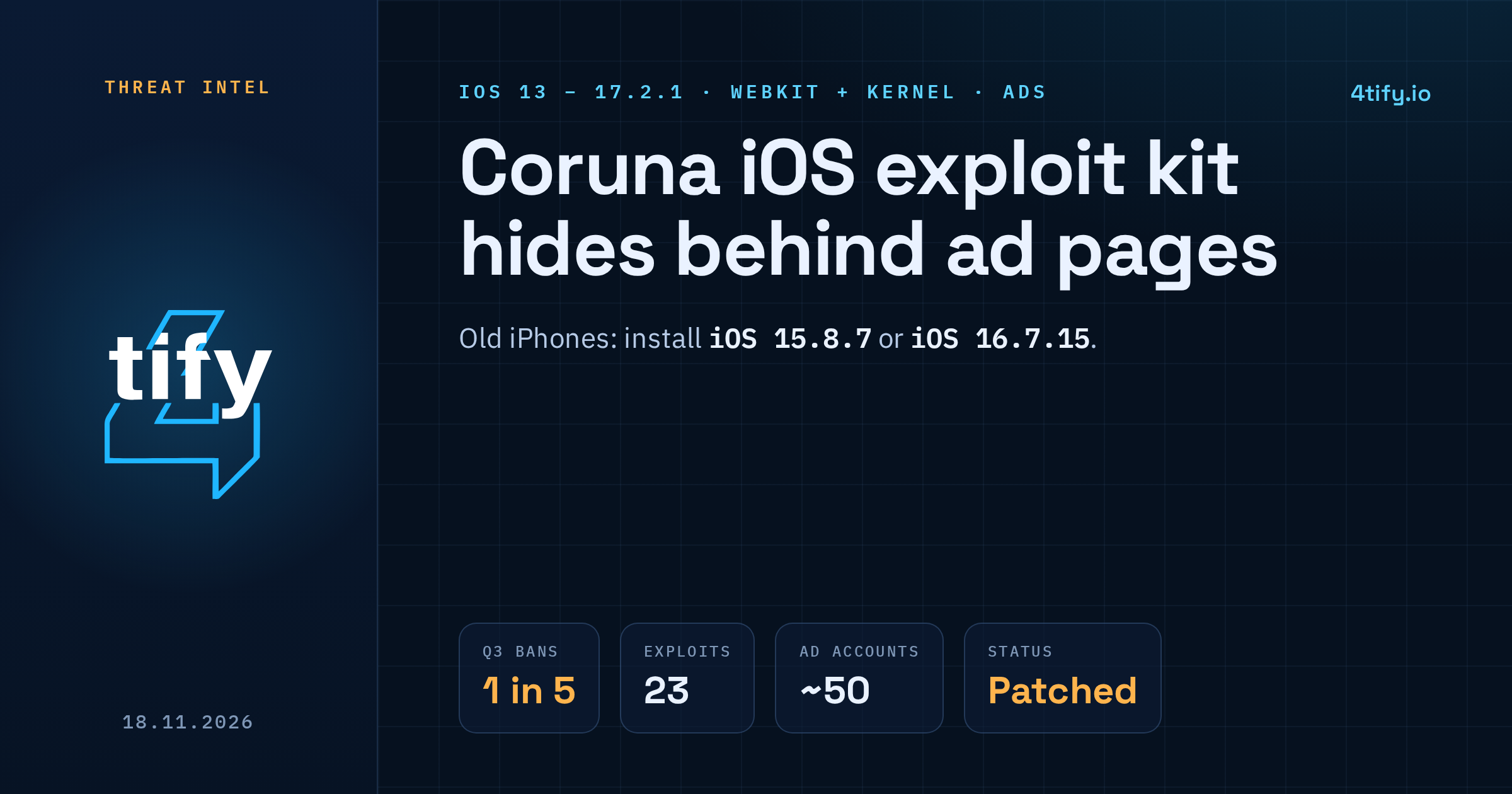
Old iPhones are being attacked through ordinary-looking ads. In the third quarter of 2026, malicious iOS scripts were behind roughly one in five advertiser suspensions on the ad platforms covered by a new industry trust-and-safety dataset. The most detailed case behind that number is a campaign that used the Coruna exploit kit to steal cryptocurrency wallet seed phrases from iPhones that had not been updated.
What happened
About 50 advertiser accounts ran campaigns that looked unrelated. The creatives, offers and landing-page designs kept changing. Underneath, the delivery was the same: the same device checks, the same script patterns and the same redirect behaviour. The ad platforms suspended the accounts under their own policies once the shared back end was spotted.
The figures come from moderation data collected between January and September 2026 across eight advertising platforms, covering 1.2 million campaigns and 4.9 million creatives. It is the first year malicious iOS scripts have been counted as a separate suspension reason. Cloaking, where a page shows reviewers something different from what real users get, is still the top reason, but its share fell from about three quarters of suspensions in 2025 to under half in Q3 2026. Phishing that moves victims into WhatsApp or Telegram chats was also split out as its own category this year.
How the attack works
A visitor who clicks the ad lands on a page that looks like a normal offer. A hidden iframe checks whether the device is a real iPhone or iPad and reads its model and iOS version. Bots, crawlers and anyone who looks like a moderator get a harmless page, which is why reviewing each landing page on its own would likely have missed the whole operation.
If the phone qualifies, the kit builds an exploit chain for that exact iOS version and chip and serves it as a file ending in .min.js, a name that blends in with the minified JavaScript found on almost every website. The final implant goes after crypto wallets and banking apps and searches the device for wallet recovery phrases.
Each platform logs one primary reason per suspension. A campaign that targets iPhones usually also uses cloaking, so the one-in-five figure probably undercounts how often device targeting shows up.
Who is affected
Coruna bundles 23 exploits in five full chains aimed at iOS 13.0 through iOS 17.2.1. It does not work on current iOS. The people at risk are those still running older firmware, often on hardware that cannot install the latest release.
Apple has fixed these bugs for supported devices since 2023. On 11 March 2026 it also shipped backports for older hardware, and it names Coruna in both notes:
- iOS 15.8.7 / iPadOS 15.8.7 for iPhone 6s, iPhone 7, iPhone SE (1st generation), iPad Air 2, iPad mini (4th generation) and iPod touch (7th generation). It fixes CVE-2023-41974 (kernel), CVE-2024-23222, CVE-2023-43000 and CVE-2023-43010 (all WebKit). The details are in Apple's iOS 15.8.7 security note.
- iOS 16.7.15 / iPadOS 16.7.15 for iPhone 8, iPhone 8 Plus, iPhone X, iPad (5th generation) and the first iPad Pro models. It fixes CVE-2023-43010, as listed in Apple's iOS 16.7.15 note.
CVE-2024-23222, CVE-2023-41974 and CVE-2023-43000 are all in the CISA Known Exploited Vulnerabilities catalog. The last two were added on 5 March 2026.
What to do now
- Update every iPhone and iPad. Open Settings > General > Software Update. Devices that can run current iOS should be on it. An iPhone 6s, 7 or first-generation SE should show iOS 15.8.7, and an iPhone 8 or X should show iOS 16.7.15. Anything older than that is still exposed.
- Check company devices, not only personal ones. Use your MDM to list devices below those versions and retire hardware that no longer gets fixes, especially phones used for banking, payments or crypto.
- If a phone cannot be updated yet, keep it away from ad-heavy browsing and turn on Lockdown Mode where the device supports it.
- Treat seed phrases as cash. Do not keep them in notes, photos or screenshots on the phone. If an outdated device held a wallet, move the funds to a new wallet created on a clean device.
- If you buy or sell ads, judge campaigns by where the click really ends up, on different devices and from different countries, not just by the creative.
The common thread here is software nobody updated. Knowing which versions your systems actually run is the first step, and it is the problem our vulnerability scanning is built for: it flags outdated, exploitable software across the servers, sites and services a company exposes before an attacker uses it.